
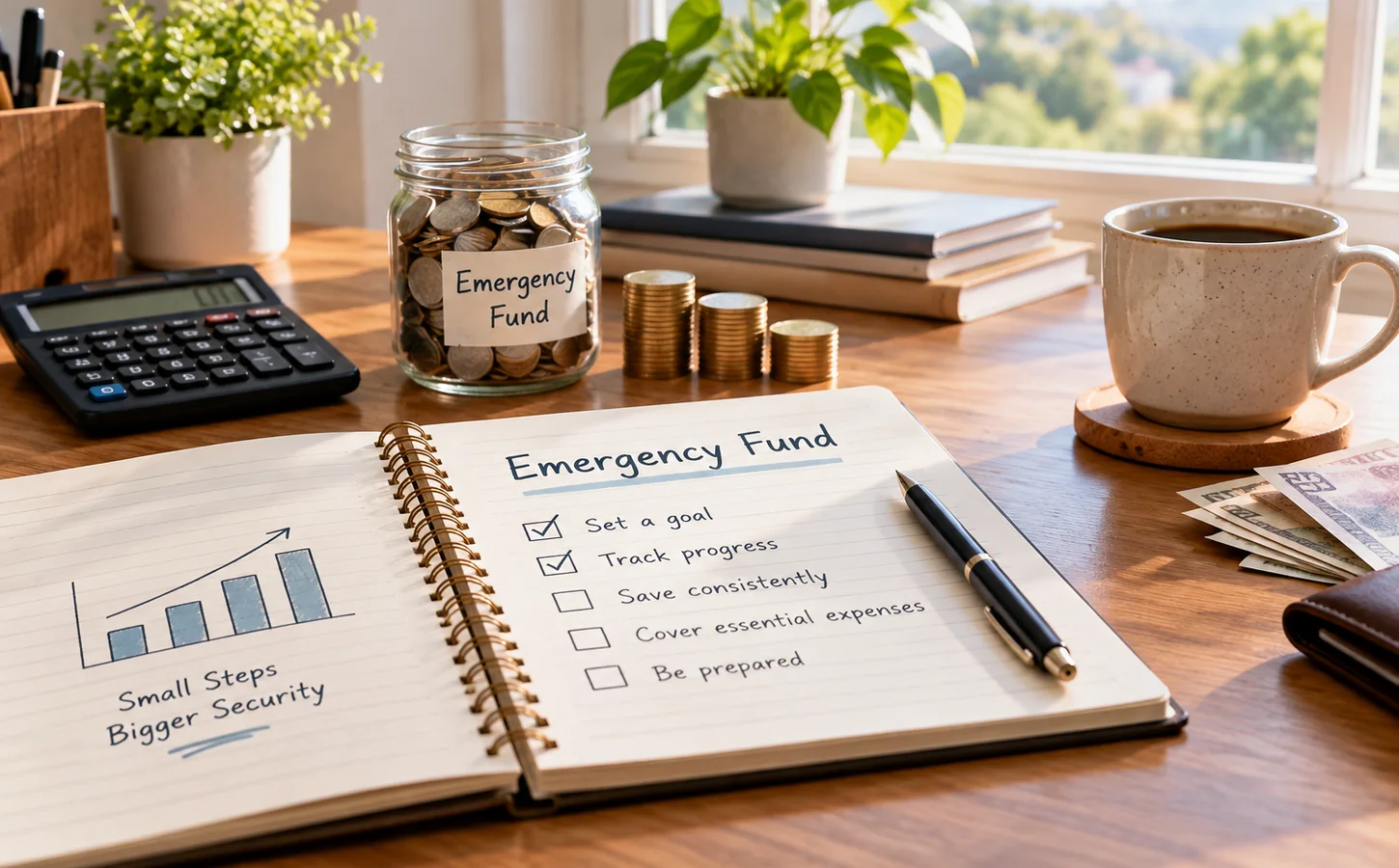
An emergency fund is money set aside for expenses you did not plan for: a sudden repair, an unexpected medical bill, a necessary trip, or a period when income drops. The useful part is not choosing a perfect number on day one. It is creating a separate reserve and a practical way to keep building it.
A good starting plan should fit the money you actually receive and the expenses you already have. You can begin small, review the target as your situation changes, and rebuild the fund after you use it.

1. Decide what your emergency fund is for
Start by defining the job of the money. An emergency fund is generally for unplanned expenses or financial emergencies rather than routine shopping, planned holidays or ordinary monthly bills.
Think about the kinds of costs that could genuinely disrupt your month: an urgent repair, an unexpected medical expense, a necessary replacement, or a temporary loss of income. The Consumer Financial Protection Bureau’s emergency-fund guidance describes the fund as a cash reserve for unplanned expenses and financial emergencies.
2. Look at your real monthly numbers
Before choosing a savings target, look at your current budget. What comes in each month? Which expenses are essential? Which costs vary? Which bills happen only a few times a year?
This matters because the size of a useful reserve depends on your circumstances. Someone with irregular income or large unavoidable expenses may need a different target from someone with predictable income and fewer fixed commitments.
If you have not built a monthly budget yet, the Monthly Budget Checklist can help you organise the numbers first.
3. Choose a starting target, not a perfect final number
There is no single emergency-fund amount that fits everyone. Instead of waiting until you can reach a large final target, choose a first milestone that is meaningful but realistic for your current cash flow.
You can base that milestone on the kinds of unexpected costs you have actually faced, or on a portion of the essential expenses you would need to cover if income temporarily changed. Once you reach the first milestone, you can reassess and decide whether the reserve should grow.
The CFPB likewise notes that the amount needed depends on a person’s situation and suggests looking at common unexpected expenses and their costs when setting a goal.
4. Make the saving amount repeatable
The most useful contribution is one you can make consistently without making the rest of the month unworkable. Look at your budget and identify an amount or percentage that fits your actual cash flow.
If your income is regular, a recurring transfer after payday can turn saving into a routine. If your income varies, you may prefer to contribute when money is available or use a combination of smaller regular amounts and occasional larger contributions.

5. Keep the fund separate from everyday spending
A separate savings account can make the boundary clearer: this money has a specific job and is not part of the amount available for ordinary purchases.
When deciding where to keep the fund, consider safety and how quickly you can access the money when you genuinely need it. The CFPB recommends a place that is safe and accessible while being less tempting for non-emergency spending.
6. Make a short list of genuine emergencies
It is easier to use a reserve consistently when you decide in advance what qualifies. Write down a few examples that match your circumstances.
A useful question is: Is this an unexpected expense that I need to handle now, and would paying it from normal monthly cash flow create a problem? If the answer is no, it may belong in the regular budget or a separate planned-savings goal instead.
7. Plan for irregular income and one-time money
If your income changes from month to month, a fixed contribution may not always be practical. You can build the habit around what is actually available instead of setting a number that forces you to keep moving money back out.
One-time money can also be an opportunity to add to the fund. The CFPB lists occasional inflows, such as a tax refund or cash gift, among the opportunities people can consider using for savings.
8. Do not treat the fund as money you must never touch
An emergency fund exists to be used when a real emergency happens. Using it for its intended purpose is not a failure.
If you need to spend part or all of the reserve, record what happened, review the new balance and restart the saving habit when your cash flow allows. Rebuilding is part of maintaining the fund.
9. Review the target when your life changes
Your emergency-fund target does not have to stay fixed forever. A move, new job, change in income, new recurring bill, family change or major change in essential expenses can alter the amount of cash reserve that makes sense for you.
Review the fund alongside your monthly budget rather than treating it as a one-time project. The goal is to keep the reserve connected to your current reality.
10. Track progress without making it complicated
You only need a few numbers: your current balance, your next target and the amount you are regularly adding. A simple note, spreadsheet or account alert can be enough.
Checking progress periodically can also help you notice when the fund has stopped growing, when your target needs updating, or when an automatic contribution no longer fits your budget.
A simple emergency-fund plan
- Purpose: define the unexpected expenses the reserve is meant to handle.
- Starting target: choose a realistic first milestone based on your situation.
- Contribution: decide what you can consistently add without creating a new cash-flow problem.
- Location: keep the money somewhere safe and reasonably accessible, preferably separate from everyday spending.
- Rules: write down what you consider a genuine emergency.
- Review: check the balance and target when your income or essential expenses change.
- Rebuild: if you use the fund, restart contributions when the immediate expense is under control.
Start with a system you can actually keep
The strongest emergency-fund plan is not necessarily the one with the biggest target. It is the one that fits your real cash flow, gives unexpected expenses their own place in your financial plan and can be maintained as your circumstances change.
Start with a clear purpose, choose a realistic first milestone and make contributions easy to repeat. Then review the plan occasionally instead of trying to solve every future scenario at once.
For more general saving guidance, see the Consumer Financial Protection Bureau emergency-fund guide. It covers building the habit, managing cash flow, choosing where to keep savings and deciding when to use the fund.
Turn the plan into a checklist
This article explains the thinking behind an emergency fund. The Emergency Fund Checklist turns the process into a shorter set of practical tasks.
If you are still working on the foundation, use the Monthly Budget Checklist to review your income and spending. The Debt Payment Checklist can help organise recurring debt-payment tasks, while the Tax Preparation Checklist can help when a tax deadline is approaching.