
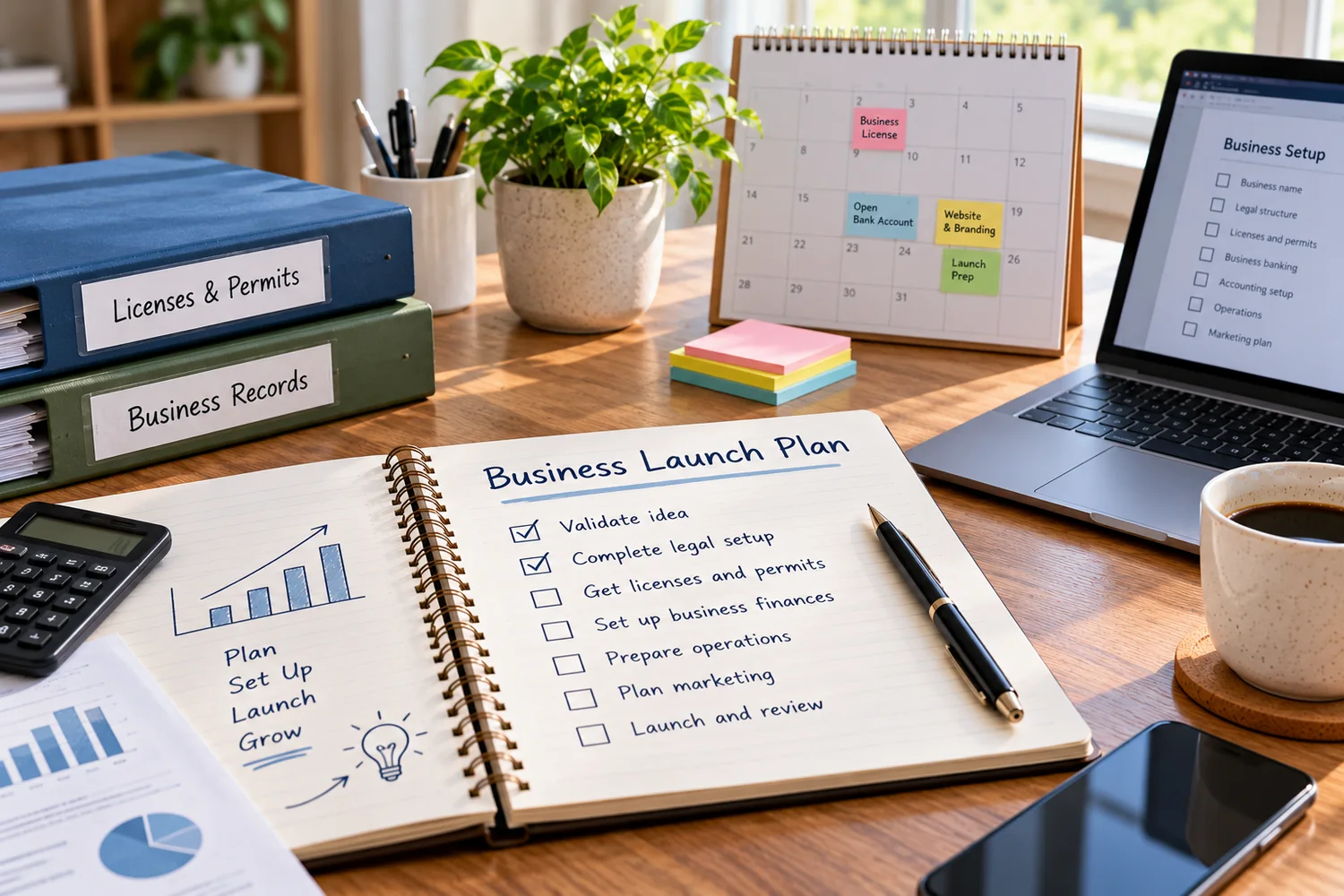
Launching a small business is more than choosing a name and announcing that you are open. Before the first customer arrives, there are decisions to make about the business model, legal structure, money, records, permissions, operations and the way customers will actually buy from you.
The exact requirements depend on the country, state or local area, business structure and industry. This article is a practical planning framework rather than legal or tax advice. Use the relevant government and professional sources for the rules that apply to your business.
Registration, taxes, licenses, permits, zoning, insurance and employment requirements can vary by location and business activity. Treat the official requirements for your area as the final source of truth.
1. Define what you are actually launching
Before paperwork, write down the simplest useful description of the business. What are you selling, who is it for, how will customers buy it, and what has to happen between an order and delivery?
This does not need to become a fifty-page business plan. A short operating outline can be enough to expose missing pieces. Include the main product or service, customer type, pricing approach, sales channel, delivery method and the main costs you expect to face.
The U.S. Small Business Administration recommends market research, competitive analysis, business planning and startup-cost estimates as part of preparing a business. Its planning guidance also distinguishes between one-time startup expenses and ongoing monthly expenses.
2. Choose the business structure and name
Your business structure can affect taxes, liability, paperwork and how the business is registered. The appropriate options depend on your jurisdiction. Do not choose a structure simply because another business uses it.
Once you understand the structure you are considering, check the name requirements in the jurisdiction where you will operate. Search for conflicts where appropriate and check whether a trade name, assumed name or other registration is required.
For U.S. businesses, the SBA says the business structure and location affect how and where registration is handled. The IRS also notes that choosing a business structure is one of the basic decisions involved in starting a business.

3. Check registration, licenses and permits
Do not assume that registering a business automatically gives you permission to carry out every activity. Licensing and permit requirements can depend on what you do and where you do it.
Make a short compliance list for your exact location and activity. It may include business registration, local registration, professional or industry-specific licenses, zoning approval, health or safety requirements, signage rules, or other permissions.
The SBA states that license and permit requirements and fees vary by business activity, location and government rules. The IRS likewise directs new businesses to check state requirements rather than relying only on federal information.
4. Separate business money from personal money
Set up a clear system for receiving business income and paying business expenses. Depending on your structure and circumstances, that may include a dedicated business bank account and a payment method that makes transactions easy to identify.
Before opening, list the accounts or payment channels you expect to use and decide how receipts, invoices and transaction records will be stored. You want to be able to answer simple questions such as: What did the business earn? What did it spend? Which customer payment does this deposit represent?
For U.S. businesses, the SBA lists opening a business bank account among the launch steps and explains that banks commonly ask for documents such as formation documents, an EIN or other taxpayer identification information, and business licenses where applicable.
5. Build a realistic startup-cost picture
Make two lists: costs you pay once to get started and costs that will continue after opening. The difference matters because a business can look affordable to launch while still having monthly expenses that need to be covered.
- Equipment and supplies
- Inventory or materials
- Registration, licenses and permits
- Insurance
- Website, software and communications
- Workspace or utilities
- Professional services
- Marketing and launch materials
- Payment processing or banking costs
- Recurring operating expenses
Use actual quotes where possible instead of guessing. SBA guidance recommends estimating startup costs and organising them into one-time and monthly expenses.
6. Decide how records will be kept
Recordkeeping should be designed before transactions pile up. Decide where invoices, receipts, contracts, bank records and other important documents will live and who is responsible for updating them.
Create a consistent naming system and a regular review routine. For example, you might reconcile transactions weekly and archive supporting documents by month. The exact system can vary, but the important part is that you can retrieve a record later without reconstructing the entire history.
The IRS identifies recordkeeping as a basic area new business owners need to address and notes that the records needed can depend on the business and its tax obligations.

7. Prepare the customer-facing side
A business can be legally ready but operationally confusing. Before opening, test the path a customer will follow.
- How does someone discover the business?
- Where do they see the offer, price and important terms?
- How do they place an order or request the service?
- How do they pay?
- How do they receive confirmation?
- How are delivery, scheduling, returns or cancellations handled?
- Where can they ask for help?
Run through the process yourself from the customer's point of view. A short test can expose missing information, broken forms, unclear payment steps or operational gaps before a real customer encounters them.
8. Write down the basic operating procedures
You do not need a manual for every possible situation on day one. Document the repeatable tasks that are most likely to cause confusion if they are handled differently each time.
Examples include opening and closing procedures, order processing, customer communication, refunds, inventory checks, appointment scheduling, document storage and end-of-day financial review. If someone else will help operate the business, these notes become even more useful.
9. Set a launch-readiness review
A launch date should not be the only milestone. Set a short review point a few days before opening and check the items that could actually stop the business from operating.
- Required registration is complete.
- Required licenses and permits have been verified.
- Business banking and payment methods work.
- Products, equipment or service materials are ready.
- Customer-facing information is accurate.
- Contracts, policies or terms are ready where needed.
- Recordkeeping is set up.
- Key suppliers or service providers are confirmed.
- Customer support and communication channels are working.
- There is a simple plan for the first week of operations.
10. Keep the first week deliberately simple
Opening is not the end of setup. Your first few transactions will show which assumptions were correct and which processes need adjustment.
Track questions customers ask, delays, unexpected costs, missing documents and repetitive manual tasks. Review those notes after the first week and turn the most useful observations into small process changes.
A practical small-business launch sequence
- Define: clarify the offer, customer and operating model.
- Plan: research the market and estimate startup and ongoing costs.
- Structure: choose the appropriate business structure and name process.
- Register: complete the registrations, licenses and permits that apply.
- Set up finances: establish banking, payments and recordkeeping.
- Prepare operations: organise suppliers, equipment, workflows and customer support.
- Test: run the customer journey and fix obvious gaps.
- Launch: open when the required pieces are ready.
- Review: use the first week of real activity to improve the system.
Turn the plan into a working checklist
This article explains the planning sequence. The Small Business Startup Checklist turns the main preparation tasks into a practical list you can work through.
When the opening date gets closer, use the Business Launch Checklist for launch-specific tasks. The Business Record-Keeping Checklist can help keep the documentation side organised after operations begin.
Official resources
For U.S. businesses, the U.S. Small Business Administration launch guidance covers structure, registration, tax IDs, licenses, banking and insurance. The SBA planning guidance covers market research, business plans and startup costs. The IRS startup checklist covers basic federal tax and setup considerations. If you are outside the U.S., use the equivalent official government sources for your jurisdiction.