
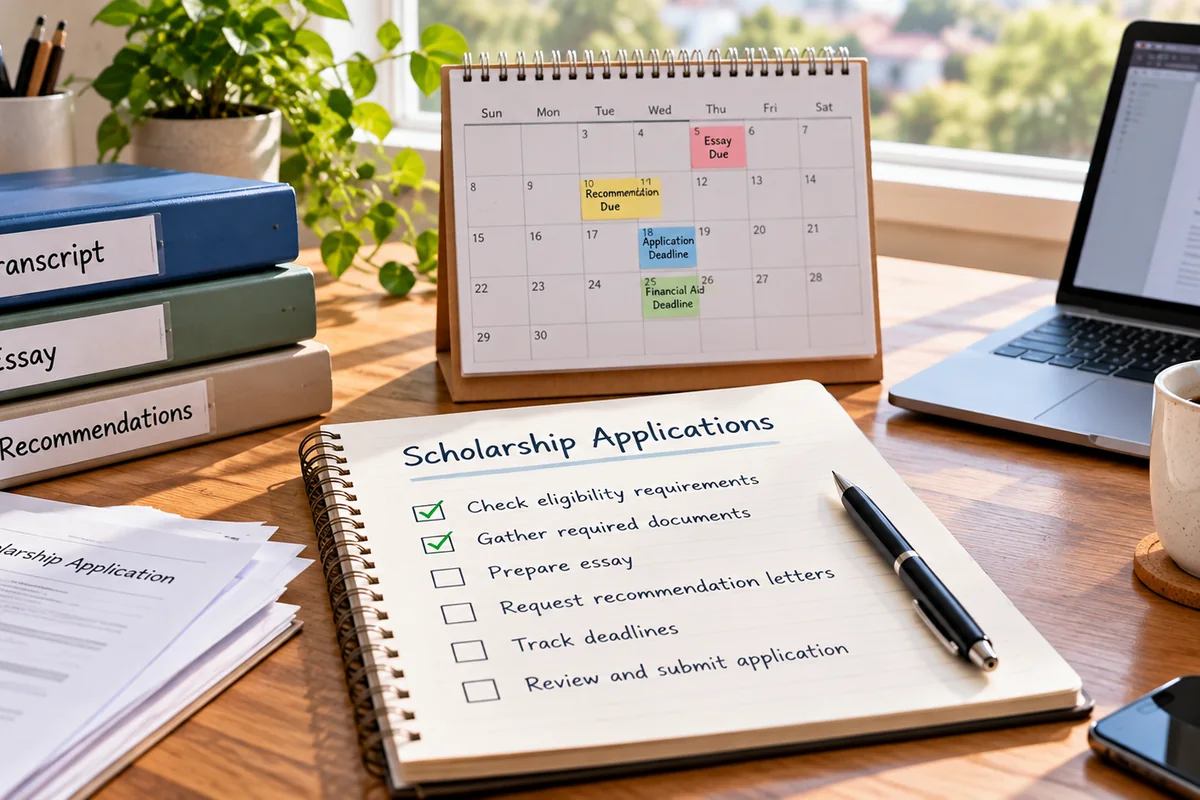
A scholarship application is easier to manage when you treat it as a small project rather than one form you fill out at the last minute. The work usually has several moving parts: eligibility rules, documents, an essay or personal statement, recommendations, a deadline and sometimes additional materials.
The requirements vary by scholarship, so the safest approach is to build a separate record for each opportunity. This article shows how to organise that record, prepare reusable materials without submitting the wrong version, and keep deadlines visible.
Eligibility, required documents, word limits, submission methods and deadlines can differ. Use this article as an organising framework, then follow the current instructions published by the scholarship provider.
1. Build a scholarship tracker before you apply
Start with a simple table. A spreadsheet is useful because you can sort it by deadline, but a notebook or document works too.
- Scholarship name and provider
- Eligibility requirements
- Application deadline and time zone, if stated
- Application link or submission method
- Required essays or personal statements
- Transcript or academic information required
- Recommendation requirements
- Resume, activities list, portfolio or other supporting material
- Financial-aid information or FAFSA-related requirements, if applicable
- Status: researching, preparing, ready to submit, submitted or follow-up needed
Federal Student Aid recommends organising scholarship applications by due date and checking that all required materials are included before submitting. It also notes that some scholarships may require an essay, recommendation, transcript or other information.
2. Check eligibility before doing the full application
Do not spend an hour writing an essay before checking whether you actually meet the scholarship’s criteria. Read the eligibility section and turn it into a short yes-or-no list.
Check requirements such as student status, year of study, field of study, location, academic criteria, community involvement or other conditions stated by the provider. If the scholarship asks for a specific document to prove eligibility, add that document to your tracker.
Keep eligibility separate from selection criteria. Meeting the eligibility requirements means you can apply; it does not guarantee an award.
3. Create a reusable document folder
Many applications ask for similar information. Creating a clean folder can save time, but reusable material still needs to be checked for each application.
A practical folder might contain:
- A current transcript or academic record, where appropriate
- A resume or activities list
- A short record of awards, volunteering, employment and extracurricular activities
- A list of recommenders and their contact details
- Draft essays and personal statements
- Final submitted copies
- A simple deadline tracker
Use clear filenames such as ScholarshipName_Essay_Final.pdf rather than leaving several files with names like essay-final-final2.docx. If a scholarship specifies a file type or naming convention, follow its instructions instead.

4. Handle recommendation letters early
Recommendations are a dependency because another person has to complete part of the application. If a scholarship requires one or more letters, ask the recommender well before the deadline.
Give the person the information they need, such as the scholarship name, deadline, submission instructions and a short summary of relevant activities or achievements. Track whether the request has been accepted and whether the recommendation has been submitted.
Do not assume that a recommendation submitted for one scholarship can automatically be reused for another. Check each application’s instructions and submission process.
5. Treat each essay as a specific assignment
Scholarship essays can look similar at first, but the prompt and word limit matter. Start by copying the exact prompt into your working document, then write a short note about what the question is actually asking.
Before polishing the wording, check four things:
- Prompt: Does the essay answer the question that was asked?
- Evidence: Does it use specific examples rather than vague claims?
- Voice: Does the writing sound like the applicant rather than a generic template?
- Limit: Is it within the stated word or character limit?
Federal Student Aid recommends giving yourself time to review scholarship essays and asking other people to look for errors and clarity. Its guidance also suggests checking the instructions and word limit before submission.
6. Separate a master draft from submitted versions
Reusing a useful paragraph or example can be efficient. Reusing an entire application without checking it can create mistakes.
Keep one master folder for general material and a separate folder for each scholarship you actually submit. Before copying anything into a new application, check the scholarship name, organisation name, prompt, word limit and any references to a particular school or programme.
This is especially important when several deadlines fall close together. A final review should confirm that the application is for the correct scholarship and contains the correct version of every attachment.

7. Work backwards from the deadline
Instead of putting the provider’s deadline on your calendar and doing everything just before it, create a few earlier checkpoints.
- Research date: confirm eligibility and requirements.
- Document date: gather transcripts, resumes and other supporting material.
- Recommendation date: request letters and confirm the submission method.
- Draft date: complete the first essay draft.
- Review date: check the application against the original instructions.
- Submission date: submit with enough time to handle a technical problem.
Federal Student Aid advises submitting scholarship applications at least a day before the deadline when possible, noting that scholarship websites can experience heavy traffic near a cutoff.
8. Do a final requirements check
The final review should be mechanical. Do not rely on memory or the fact that the application looks complete.
- Eligibility was checked.
- Every required field is complete.
- The essay answers the current prompt.
- The essay is within the stated limit.
- Recommendations have been submitted or the application shows the correct status.
- The transcript or academic document is the correct version.
- Every attachment opens correctly and uses the requested format.
- The scholarship name and provider are correct throughout.
- The deadline and submission method were checked on the provider’s current instructions.
- A copy of the submitted application and confirmation has been saved.
9. Keep financial-aid tasks separate
Some scholarships may ask for information connected to financial aid, but a scholarship application and a federal or institutional financial-aid application are not automatically the same process.
For U.S. students, Federal Student Aid says the FAFSA can be used to determine eligibility for federal, state and school financial aid, and some scholarship providers may ask for FAFSA-related information. Check the current requirements for the scholarship and school rather than assuming one submission covers everything.
If you are applying outside the U.S., use the financial-aid process that applies to your country and institution.
10. Watch for scholarship scams
Be careful with scholarship opportunities that ask for unusual payments or sensitive information before you have verified the provider. Federal Student Aid advises students to use trusted sources and notes that students do not have to pay to find federal student aid or scholarships.
If an opportunity looks unfamiliar, verify the organisation through an independent official source and check with a school financial-aid office or counselor when appropriate.
A simple scholarship application workflow
- Find: collect scholarships from school, community, employer and other legitimate sources.
- Check: confirm eligibility before investing time in the application.
- Track: record the deadline, requirements and status.
- Prepare: gather documents and request recommendations early.
- Write: answer each essay prompt specifically and respect the limit.
- Review: compare the finished application against the provider’s instructions.
- Submit: send it before the final cutoff and save confirmation.
- Follow up: watch for requests or status updates after submission.
Turn the plan into a working checklist
This article explains the organisation system. The Scholarship Application Checklist turns the main tasks into a practical list you can work through.
If you are managing scholarships alongside college applications, the College Application Checklist can keep admission tasks separate. The Study Checklist can help keep regular academic work visible while application deadlines are approaching.
Official resources
For current scholarship guidance, see Federal Student Aid’s scholarship tips and College Board’s scholarship application guidance. Requirements and deadlines should always be confirmed with the scholarship provider itself.