
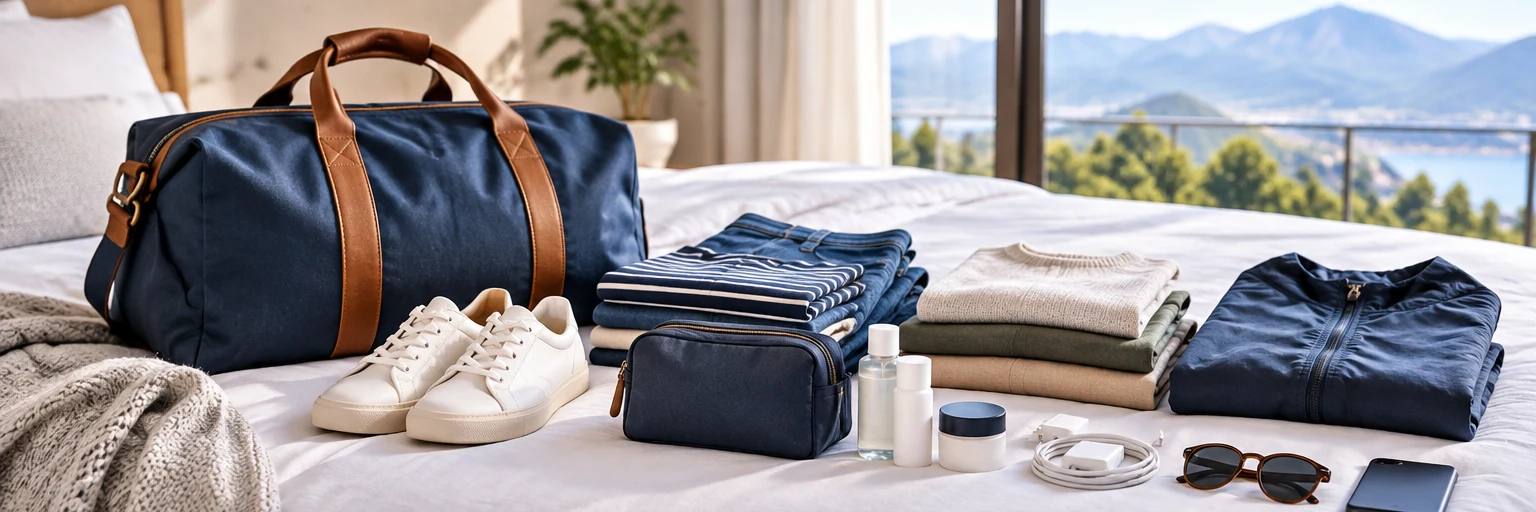
A weekend trip sounds simple until you start packing. You put a few clothes on the bed, add another outfit “just in case,” throw in a second pair of shoes, add toiletries, chargers and something for the weather—and suddenly a two-night trip needs a suitcase that looks ready for two weeks.
The trick is not to become an extreme minimalist. It is to make every item earn its place. For a short trip, start with the activities, weather and accommodation rather than packing for every possible situation. Then use the Weekend Trip Packing Checklist for the final check.

1. Start with the trip, not the suitcase
Before opening your bag, answer three questions: Where am I going? What am I doing? What will the weather be like?
A weekend spent mostly walking around a city needs a different bag from a weekend at a beach resort or a family event. Look at your actual plans and make a very short list of the situations you expect to encounter.
- Travelling and sightseeing
- One evening out
- Sleeping
- Morning and evening toiletries
- Weather-specific needs
That gives you a much better starting point than simply asking what you might possibly need.
2. Choose clothes that work together
The easiest way to overpack clothes is to choose complete outfits individually. Instead, choose a small group of clothes that can be mixed together.
If one pair of trousers works with three tops, it has much more value in a weekend bag than three outfits that can only be worn one way. The same idea works for shoes. If your walking shoes can also work for a casual dinner, there may be little reason to bring another pair.
REI’s packing guidance similarly recommends versatile items that can serve more than one purpose and clothing that can be combined into multiple outfits. Their packing-light advice is a useful reference when you are deciding what can stay home.

3. Pack for the actual weather
Weather is one of the easiest reasons to overpack. People often respond to uncertainty by packing several versions of everything: a heavy jacket, a light jacket, extra layers, an umbrella, extra shoes and clothes for completely different conditions.
Instead, check the forecast shortly before you leave and pack around the conditions you are actually expecting. If rain is possible, one useful rain layer may be more practical than carrying multiple extra outfits. If temperatures change throughout the day, layers can be more useful than one bulky item that only works in a narrow temperature range.
4. Give shoes special attention
Shoes take up an unreasonable amount of space for something you usually only need a couple of pairs. For many weekend trips, one comfortable pair may be enough. If you need another pair, make sure it serves a genuinely different purpose.
Wear the heavier pair during travel when practical rather than giving it valuable space inside the bag. Most importantly, do not take a brand-new pair of shoes just because they look good with your planned outfit. A weekend involving lots of walking is not the place to discover that your new shoes cause blisters.
5. Keep toiletries small
Toiletries are another easy place to accumulate unnecessary weight. Look at what you actually use during a normal two- or three-day period. You probably do not need full-size bottles of products that you will use only a few times.
If your accommodation already provides some basic items, check before packing them. For other products, use smaller containers where appropriate or buy what you need after arrival if that makes sense for the destination.
6. Create one small “must not forget” group
Some things are annoying to forget but easy to replace. Others can seriously disrupt the trip. Separate those two categories.
Your important group might include identification and travel documents, medication, your phone, wallet or payment cards and keys. Keep these together or in predictable places rather than allowing them to disappear into the bottom of your luggage.
7. Do not fill every empty space
If your bag has extra room, leave it empty. An empty corner is not a problem that needs solving. You may buy something during the trip, your clothes may be packed differently on the way home, or you may simply appreciate having a lighter bag.
A larger suitcase can make overpacking easier because the available space encourages you to fill it. Choose luggage that is appropriate for the trip rather than automatically taking the largest bag you own.
8. Do a trial pack before the final pack
If you are unsure whether everything will fit, pack the bag once before the night before your trip. Then pick it up. If it already feels heavier than you want to carry through a station, airport or several streets, that is useful information.
Take everything back out and look for duplicates. Ask yourself: Do I have two things that do the same job? Am I carrying something only because it might be useful? Can I wear something twice? Can I use a smaller version? Can I buy it at the destination if I genuinely need it?
9. Keep the bag organized
Packing light and packing badly are not the same thing. You should still be able to find things without emptying the entire bag.
Packing cubes, small pouches or simple groups can help separate clothes, toiletries, electronics and smaller belongings. Their main benefit is organization rather than magically creating more space. Keep anything you are likely to need during the journey somewhere accessible.
The final test
Before you close the bag, look at everything you have packed. Then remove one or two things you are least certain about.
If you immediately realize you genuinely need them, put them back. If you cannot remember why they were there, leave them out. That small pause is often enough to catch the “just in case” items that turn a light weekend bag into an unnecessarily heavy one.
A simple weekend packing approach
- Start: Check your plans, destination and weather.
- Choose: Pick clothes that work together instead of building separate outfits.
- Reduce: Look for duplicate shoes, toiletries and “maybe” items.
- Organize: Keep important items accessible and group smaller belongings.
- Test: Carry the packed bag before you leave.
- Final check: Use the Weekend Trip Packing Checklist to make sure you did not remove something genuinely important along with the unnecessary extras.
The goal is not to see how little you can take. It is to arrive with everything you actually need and very little that you don’t.
If the trip is international, the International Travel Checklist covers the broader preparation beyond packing. For work trips, the Business Travel Checklist is a better companion.
Useful reference: REI’s packing-light guidance covers versatile clothing, multipurpose footwear, luggage size and organizing a lighter bag. Airline baggage limits vary, so check your airline’s current rules before departure.